3D vs 4D Massage Chair 3D vs 4D vs 5D Explained

Introduction 3D vs 4D Massage Chair
Quick Answer: What’s the Core Difference?
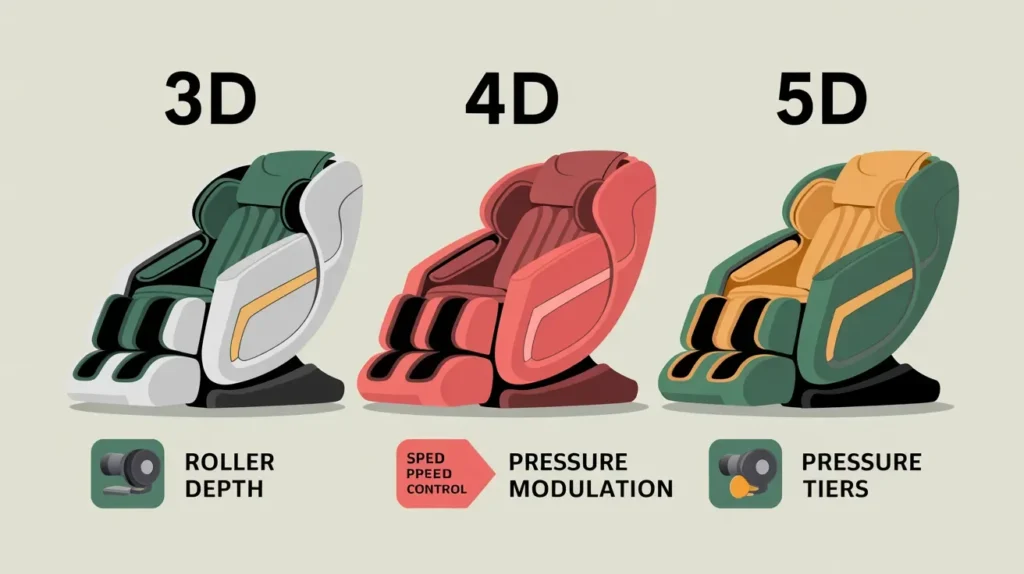
When comparing a 3D vs 4D massage chair, the main difference is how natural and adjustable the massage feels. A 3D massage chair controls depth, while a 4D massage chair adds variable speed and rhythm, making the massage feel more human-like and customizable.
Why This Matters (Comfort, Therapy, Price, Longevity)
Understanding the 3D vs 4D massage chair difference matters because it directly affects your comfort, pain relief, and overall value for money.
- Comfort: 4D massage chairs feel smoother and more realistic due to changing speed and pressure.
- Therapeutic benefit: If you suffer from chronic back pain or muscle stiffness, 4D massage chairs often provide better relief than standard 3D models.
- Price: 3D chairs are usually more affordable, while 4D chairs cost more due to advanced technology.
- Longevity & satisfaction: Choosing the right level prevents overpaying for features you don’t need or underbuying and feeling disappointed later.
How to Read This Guide
This guide breaks down the 3D vs 4D massage chair comparison in simple terms, without technical jargon. You’ll learn:
- What 3D, 4D, and even 5D massage chairs really mean
- Who each type is best for (casual users, pain relief seekers, or premium buyers)
- Whether upgrading to 4D is actually worth it for your needs
- How to choose the right massage chair confidently and avoid common buying mistakes
By the end, you’ll clearly know which option fits your body, budget, and lifestyle best.
What Does “3D”, “4D” and “5D” Mean? (3D vs 4D Massage Chair Explained)
Understanding the terms behind a 3D vs 4D massage chair comparison can feel confusing at first. The good news is that these labels mainly describe how the massage rollers move and how realistic the massage feels. Let’s break each one down in simple, beginner-friendly terms.
3D Massage Chairs: Definition & Core Technology

In a 3D vs 4D massage chair comparison, 3D massage chairs are the foundation.
A 3D massage chair uses rollers that move in three directions:
- Up and down along your spine
- Left and right across your back
- In and out (depth control) to press deeper into muscles
This “in-and-out” motion is what separates 3D from older 2D massage chairs. It allows the chair to:
- Adjust pressure based on your body shape
- Reach deeper muscle layers
- Let users manually increase or reduce massage intensity
Best for:
- Beginners
- Light to moderate muscle tension
- Users who want solid massage performance at a lower price
In short, 3D chairs offer good depth and pressure, but the massage speed usually stays constant.
4D Massage Chairs: What’s Added (and Why It Feels More Human)

When comparing a 3D vs 4D massage chair, the jump to 4D is all about realism.
A 4D massage chair includes everything a 3D chair does plus:
- Variable roller speed
- Acceleration and deceleration
- Rhythm and timing changes during the massage
Instead of moving at one steady pace, 4D rollers slow down, speed up, and pause—similar to how a real massage therapist works.
This allows:
- More natural, “hand-like” massage strokes
- Better muscle relaxation
- Greater customization for different pain levels
Common marketing claims you’ll see:
- “Human-like massage”
- “Therapist-style motion”
- “Advanced deep tissue massage”
These claims are often valid—but only if the 4D system is well-designed.
Best for:
- Chronic back or shoulder pain
- Athletes or physically active users
- People upgrading from a 3D chair
This is why many buyers ask: is 4D massage worth it? For most users seeking realism and control, the answer is yes.
5D Massage Chairs: What’s Beyond 4D?
In the 3D vs 4D massage chair discussion, 5D chairs often cause the most confusion.
There is no universal industry definition for 5D massage. Instead, brands use “5D” to describe enhanced 4D systems that may include:
- Smarter pressure modulation
- Advanced motion patterns
- AI body scanning and auto-adjustments
- More personalized massage programs
Some brands suggest an “extra dimension,” but this usually refers to software intelligence, not a new physical roller direction.
Important to know:
- One brand’s 5D may feel similar to another brand’s 4D
- Performance depends more on build quality than the label
Best for:
- Premium buyers
- Users who want maximum customization
- Tech-focused shoppers
This explains the frequent question about the difference between 4D and 5D massage. It’s often about smarter control, not stronger pressure.
Quick Glossary (Simple Definitions)
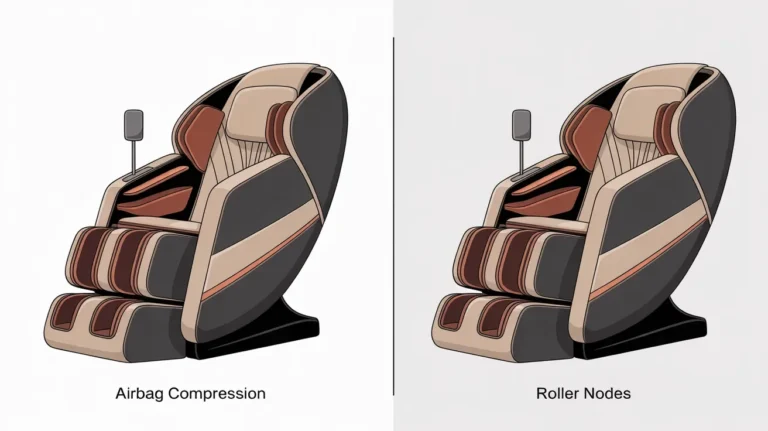
- Rollers Mechanical massage nodes that move along your back to simulate hands, thumbs, or elbows.
- SL-Track vs L-Track
- SL-Track: Follows the natural S-curve of the spine and extends under the glutes
- L-Track: Extends straight down from the neck to the seat
- Airbags Inflatable cushions that provide compression massage for shoulders, arms, hips, legs, and feet.
- Zero Gravity A reclined position that evenly distributes body weight, reducing spinal pressure and improving massage effectiveness.
- Intensity How strong the massage pressure feels.
- Speed How fast the rollers move.
- Tempo / Rhythm How the massage speed changes over time this is a key advantage in a 4D massage chair.
How Each Technology Works (Simple Visual Walkthrough) 3D vs 4D Massage Chair
Understanding how the technology actually works makes the 3D vs 4D massage chair comparison much clearer. Instead of focusing on marketing terms, this section explains what’s happening inside the chair and how it translates to real comfort.

Roller Mechanics: How 3D Rollers Move vs How 4D Adds Timing
The core of any 3D vs 4D massage chair difference starts with the rollers.
3D massage chair roller movement
- Rollers move up and down along the spine
- Rollers move left and right across muscles
- Rollers move in and out to control depth and pressure
This allows a 3D chair to press deeper into muscles compared to older 2D chairs. However, the speed of movement is usually constant, meaning the massage can feel mechanical or repetitive over time.
4D massage chair roller movement A 4D massage chair does everything a 3D chair does, but adds:
- Variable speed control
- Acceleration and deceleration
- Pause-and-press movements
Instead of rolling at one steady pace, the rollers change speed mid-stroke. This creates a more natural massage pattern similar to how a human therapist slows down on tight spots and speeds up on relaxed areas.
Key takeaway: In a 3D vs 4D massage chair, 3D controls where and how deep the rollers move, while 4D controls how they move over time.
Sensors & Software: How 4D and 5D Features Are Implemented
Another major part of the 3D vs 4D massage chair comparison is what happens beyond the rollers.
Body scanning technology Most modern chairs use sensors to:
- Detect spine length and shoulder height
- Adjust roller paths automatically
- Reduce the need for manual setup
This feature exists in both advanced 3D and most 4D chairs.
4D software enhancements In a 4D massage chair, software controls:
- Speed changes during each stroke
- Pressure timing for deeper muscle release
- Program variations for relaxation vs deep tissue
5D software enhancements When brands talk about 5D massage, they often mean:
- Smarter pressure modulation using sensors
- AI-based user profiles
- Auto-adjusting programs based on tension points
This is why the difference between 4D and 5D massage is usually about intelligence and personalization, not raw strength.
Important note: A well-built 4D massage chair can feel better than a poorly designed 5D chair. Software quality matters more than the label.
Real-World Feel: What Users Notice in 3D vs 4D vs 5D
Here’s how the 3D vs 4D massage chair difference feels in everyday use:
3D massage chair feel
- Firm and consistent pressure
- Good for general relaxation
- Can feel robotic during longer sessions
4D massage chair feel
- Smoother, more fluid motion
- Better muscle release
- Feels closer to a real massage therapist
This is why many buyers ask, is 4D massage worth it? For users who value realism and comfort, the upgrade is noticeable.
5D massage chair feel
- Highly adaptive sessions
- Pressure and rhythm adjust automatically
- Best for users who want “set it and forget it” customization
Side-by-Side Comparison 3D vs 4D Massage Chair (Quick Overview)

Feature Comparison Table (Explained)
| Feature | 3D | 4D | 5D |
|---|---|---|---|
| Roller Movement (Axes) | Vertical, horizontal, depth (in/out) | Same axes as 3D | Same physical axes (no new direction added) |
| Speed Control | Fixed or limited | Fully variable | Adaptive and automated |
| Acceleration / Timing | No | Yes | Advanced timing with smart programs |
| Pressure Modulation | Manual adjustment | Manual + program-based | Sensor-driven and AI-assisted |
| Customization | Basic | High | Very high |
| Price Band | Budget to mid-range | Mid-range to premium | Premium |
| Best For (Use Case) | Casual users, beginners, budget buyers | Pain relief, athletes, frequent use | Tech lovers, luxury buyers, hands-free personalization |
Are Higher “D” Chairs Actually Better? (Value & Performance in a 3D vs 4D Massage Chair Comparison)
When comparing a 3D vs 4D massage chair, many buyers assume that a higher number automatically means better performance. In reality, the value depends on how you use the chair, why you need it, and how well the technology is implemented. Let’s break it down clearly.

When 4D or 5D Adds Real Benefit
In a 3D vs 4D massage chair comparison, 4D and 5D chairs truly shine in specific situations.
4D massage chairs add real value if you:
- Experience chronic back, neck, or shoulder pain
- Have muscle knots that need slow, controlled pressure
- Use the chair frequently (daily or several times a week)
- Want a massage that feels closer to human hands
Because 4D massage chairs adjust speed, rhythm, and pressure timing, they can:
- Slow down on tight muscles
- Speed up on relaxed areas
- Deliver deeper relief without feeling harsh
This is why many users conclude that 4D massage is worth it for long-term comfort and pain management.
5D massage chairs add value if you:
- Want maximum automation and personalization
- Prefer “set it and forget it” programs
- Like AI-based body scanning and adaptive massage sessions
For these users, the difference between 4D and 5D massage is about convenience and smart adjustments not raw strength.
When Higher “D” Is Mostly Marketing
Not every 3D vs 4D massage chair upgrade is meaningful.
Higher “D” labels can be mostly marketing when:
- Speed changes are minimal or barely noticeable
- Pressure feels the same across all programs
- Customization options are limited despite premium pricing
- Build quality (rollers, motors, padding) is poor
A well-built 3D massage chair can feel better than a low-quality 4D or 5D chair. This is why testing matters more than the label.
Important truth: More “D” does not automatically mean deeper or better massage, it means more control if implemented correctly.
Cost vs Benefit: What to Expect
Understanding cost is essential in any 3D vs 4D massage chair decision.
Typical price ranges
- 3D massage chair: Entry to mid-range pricing; best value for beginners
- 4D massage chair: Mid-range to premium; best balance of realism and price
- 5D massage chair: Premium pricing; luxury and tech-focused buyers
Maintenance considerations
- Higher-end chairs may need specialized parts
- Software updates are more common in 4D/5D models
- Warranty length becomes more important as price increases
Bottom line: If your budget allows, a quality 4D massage chair often offers the best return on investment in a 3D vs 4D massage chair comparison.
Step-by-Step Guide: How to Pick the Right Chair for You (3D vs 4D Massage Chair)
Choosing the right chair becomes much easier when you follow a simple process instead of chasing features.
Step 1 Define Your Goals

Start by asking why you want a massage chair.
- Relaxation & stress relief: A 3D massage chair may be enough
- Pain relief & muscle recovery: A 4D massage chair is usually better
- Rehab or daily therapy use: Consider high-quality 4D or advanced 5D
- Sleep support: Look for smooth motion, zero gravity, and quiet operation
Your goal determines whether the 3D vs 4D massage chair upgrade is justified.
Step 2 Set a Realistic Budget

Match your expectations to your budget.
- Entry budget: Mostly 3D massage chairs
- Mid-range budget: Strong 3D models and quality 4D options
- Premium budget: Advanced 4D and select 5D massage chairs
Avoid overspending on features you won’t use. Many buyers find the sweet spot is a mid-range 4D massage chair.
Step 3 Prioritize the Right Features

Instead of focusing only on the “D,” look at features that affect comfort.
Key priorities in a 3D vs 4D massage chair decision:
- Track length (SL-track preferred for full-body coverage)
- Roller depth and smoothness
- Airbags for shoulders, arms, hips, and legs
- Heat therapy for lower back
- Zero gravity positioning
- Warranty length and coverage
A feature-rich 3D chair can outperform a stripped-down 4D model.
Step 4 Test in Person (If Possible)

Testing is one of the most overlooked steps.
During a demo, check:
- Roller depth (too weak or too aggressive?)
- Noise level during operation
- Program variety and transitions
- Ease of adjusting intensity, speed, and width
- Comfort after 10–15 minutes of use
This hands-on experience makes the 3D vs 4D massage chair difference immediately clear.
Step 5 Read Reviews & Check Brand Support

Before buying:
- Read long-term user reviews (not just first impressions)
- Check warranty length and what it covers
- Confirm availability of replacement parts
- Research brand reputation and customer support quality
Good support can matter more than extra features.
Step 6 Final Checklist Before Purchase

Before clicking “buy,” confirm:
- The chair fits your height and weight
- It matches your primary goal (relaxation vs pain relief)
- The price aligns with real benefits not just marketing
- Warranty and service support are solid
- You’ve compared at least one 3D vs 4D massage chair option side by side
How to Use a 3D / 4D / 5D Massage Chair: Beginner’s Step-by-Step (3D vs 4D Massage Chair)
If you’re new to massage chairs, learning how to use them properly is just as important as choosing between a 3D vs 4D massage chair. Using the chair the right way improves comfort, prevents soreness, and helps you get real value from the technology.
Safety First: Medical Considerations

Before using any massage chair whether it’s part of a 3D vs 4D massage chair comparison—keep safety in mind.
You should consult a doctor before use if you:
- Are pregnant
- Have heart conditions or a pacemaker
- Have spinal injuries, herniated discs, or recent surgery
- Have severe osteoporosis or nerve disorders
General safety tips
- Start with low intensity, especially on your first session
- Avoid using the chair for more than 30 minutes at a time
- Stop immediately if you feel pain, dizziness, or discomfort
Massage chairs are meant for relief and relaxation not pain.
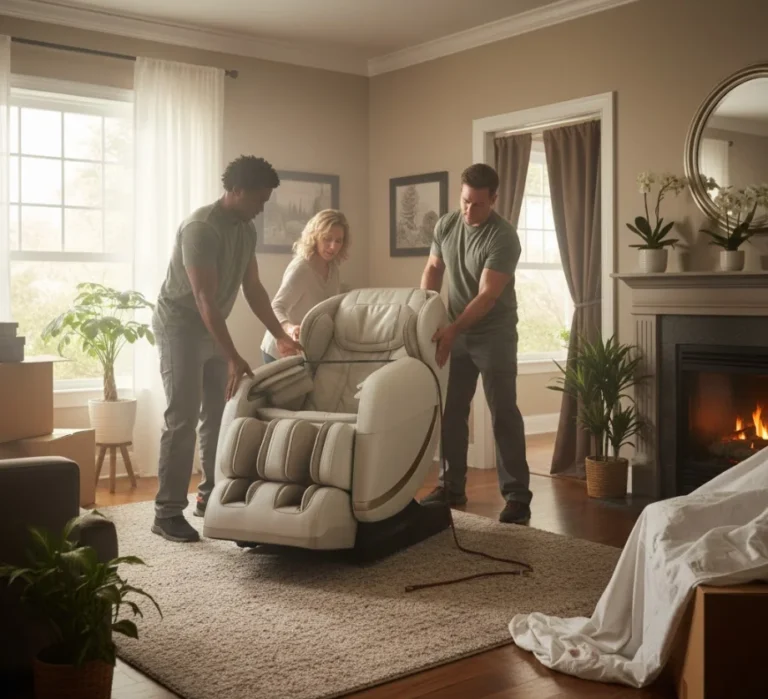
Basic Setup: Space, Power, and Positioning

Proper setup ensures your 3D vs 4D massage chair works correctly and safely.
Space requirements
- Leave at least 6–12 inches behind the chair (some models need more when reclining)
- Make sure there’s enough room for full recline and zero-gravity positions
Power & placement
- Plug directly into a wall outlet (avoid extension cords)
- Place the chair on a flat, stable surface
- Keep away from moisture or heat sources
Chair orientation
- Sit all the way back so your hips touch the backrest
- Align your neck and shoulders with the headrest
- Rest arms fully inside armrests for proper airbag function
Correct positioning makes the difference noticeable in any 3D vs 4D massage chair experience.
First Session Walkthrough: What to Do Step by Step

Your first session sets the tone for future comfort.
Step 1: Start with a warm-up program
- Choose an automatic “Relax” or “Full Body” mode
- Let the chair scan your body (usually takes 30–60 seconds)
Step 2: Adjust intensity and depth
- In a 3D massage chair: adjust roller depth or intensity
- In a 4D massage chair: adjust depth and speed
- Keep settings light for the first session
Step 3: Control speed and width
- Slower speeds feel deeper and more therapeutic
- Wider roller spacing is gentler; narrow spacing feels more targeted
Step 4: Session duration
- First-time users: 10–15 minutes
- Increase gradually over time
This gradual approach helps your body adapt especially when upgrading in a 3D vs 4D massage chair setup.
Tuning 4D / 5D Features: Getting the Best Results

This is where the 3D vs 4D massage chair difference becomes most noticeable.
Using rhythm and tempo (4D chairs)
- Slow tempo = deep muscle release
- Fast tempo = energizing massage
- Use pauses for tight or sore areas
Pressure settings
- Increase pressure slowly
- Avoid max settings until you’re comfortable with the chair
Custom profiles (4D & 5D chairs)
- Save your preferred depth, speed, and area focus
- Some 5D chairs automatically adjust based on your body scan and past sessions
If you’re wondering if 4D massage is worth it, this level of control is often the deciding factor.
Example Massage Routines (Beginner-Friendly)

Here are simple routines you can use with any 3D vs 4D massage chair.
5–10 Minute Quick Relief
- Mode: Relax or Stretch
- Intensity: Low to medium
- Speed: Medium
- Best for: Stress relief, short breaks, daily use
15–20 Minute Daily Comfort
- Mode: Full Body
- Intensity: Medium
- Speed: Medium-slow
- Best for: Office workers, mild muscle tension
20–30 Minute Deep Recovery
- Mode: Deep Tissue (4D preferred)
- Intensity: Medium-high
- Speed: Slow
- Best for: Athletes, chronic tension, post-workout recovery
Avoid multiple long sessions in a single day.
Maintenance & Troubleshooting: Simple Care Tips (3D vs 4D Massage Chair)
Good maintenance keeps your 3D vs 4D massage chair performing smoothly for years.

Regular Cleaning & Fabric Care
Weekly care
- Wipe down leather or fabric with a soft, dry cloth
- Use manufacturer-approved cleaner for synthetic leather
Monthly care
- Check seams and stitching
- Clean remote control and armrest panels
Avoid
- Harsh chemicals
- Excessive water
- Sitting with sharp objects in pockets
Clean surfaces also improve hygiene and comfort.
8 Easy Steps How to Clean and Maintain Your Massage Chair
Software Updates & Program Resets
Modern 4D and 5D chairs rely on software.
What to do
- Check for firmware updates if supported
- Restart the chair occasionally to reset programs
- Follow the manual for factory reset instructions
Software updates can improve performance especially in advanced 3D vs 4D massage chair models.
Common Small Issues & Quick Fixes
Roller noise
- Mild noise is normal
- Louder sounds may mean loose screws or debris
- Contact support if noise increases suddenly
Airbag issues
- Check tubing connections
- Make sure settings aren’t disabled in the menu
Remote or controller problems
- Replace batteries (if applicable)
- Restart the chair
- Check cable connections
Most issues are minor and easy to resolve.
When to Call Support & What to Expect from Warranty
Call customer support if:
- Rollers stop moving
- Chair won’t recline or power on
- Error codes persist after reset
- Airbags fail completely
Warranty expectations
- Typically 1–3 years for parts
- Premium models may offer in-home service
- Labor coverage varies by brand
Always keep your purchase receipt and warranty documents especially for higher-end 3D vs 4D massage chair models.
Tips Get the Most Out of Your Massage Chair (3D vs 4D Massage Chair)
No matter where you land in the 3D vs 4D massage chair decision, how you use the chair plays a huge role in comfort, safety, and long-term satisfaction. These practical tips help beginners and experienced users get better results from any massage chair.

Best Practices for Comfort and Safety
To get the best experience from a 3D vs 4D massage chair, always prioritize comfort over intensity.
Key best practices
- Start every session on low to medium intensity, especially if you’re new
- Increase depth or speed gradually over several days
- Keep sessions between 10–30 minutes
- Sit back fully so rollers align with your spine correctly
- Use zero gravity mode when available to reduce spinal pressure
Avoid using the chair when you’re extremely sore, injured, or fatigued. A massage chair should leave you relaxed, not bruised or stiff the next day.
How to Combine Chair Use with Stretches or Exercises
A 3D vs 4D massage chair works even better when paired with light movement.
Before using the chair
- Do gentle neck rolls and shoulder shrugs
- Stretch hamstrings and lower back lightly
This warms muscles and improves massage effectiveness
After using the chair
- Perform slow stretches while muscles are relaxed
- Focus on hips, lower back, and shoulders
- Drink water to support muscle recovery
For active users or athletes, a 4D massage chair combined with post-workout stretching can significantly improve recovery and flexibility.
Using Seat Heat, Zero Gravity & Timed Programs Effectively
These features make a noticeable difference in a 3D vs 4D massage chair experience.
Seat heat
- Use heat before or during massage to loosen tight muscles
- Lower back heat pairs well with slow, deep programs
- Avoid prolonged heat if you have circulation issues
Zero gravity
- Distributes body weight evenly
- Allows rollers to work deeper with less pressure
- Especially helpful for back pain and spinal decompression
Timed programs
- Short sessions (5–10 min): stress relief or quick breaks
- Medium sessions (15–20 min): daily relaxation
- Longer sessions (20–30 min): deep recovery (limit frequency)
Using these features correctly often answers the question, is 4D massage worth it? because they enhance comfort without increasing intensity.
Saving Money: New vs Refurbished & Best Time to Buy
You don’t have to overspend on a 3D vs 4D massage chair purchase.
Buy new if
- You want full warranty coverage
- You’re buying a high-end 4D or 5D model
- Long-term reliability is your priority
Buy refurbished if
- It’s factory-certified
- Comes with at least a 1-year warranty
- The discount is significant (30–50% off retail)
Best times to buy
- Black Friday / Cyber Monday
- End-of-year clearance sales
- Brand anniversary promotions
Smart timing can get you a better 4D massage chair for the price of a basic 3D model.
Common Mistakes to Avoid (3D vs 4D Massage Chair)
Many buyers regret their purchase not because the chair is bad but because of avoidable mistakes during selection or use.

Buying Only on “D” Marketing Without Trying the Chair
One of the biggest 3D vs 4D massage chair mistakes is assuming higher numbers mean better comfort.
- A poor-quality 4D chair can feel worse than a well-built 3D chair
- “5D” labels vary widely between brands
- Real comfort depends on roller smoothness, track design, and software quality
Always test the chair or read long-term user reviews before buying.
Ignoring Track Length & Body Fit (Tall vs Short Users)
Track length matters just as much as roller technology.
Common issues
- Short users may feel rollers miss the neck or shoulders
- Tall users may feel incomplete lower-back or glute coverage
In any 3D vs 4D massage chair, look for:
- Adjustable body scan settings
- SL-track design for full-body coverage
- Height and weight compatibility listed by the manufacturer
A perfect “D” level won’t help if the chair doesn’t fit your body.
Overusing High-Intensity Programs (How Often Is Too Often?)
More intensity does not equal better results.
General guidelines
- Deep programs: 2–4 times per week
- Light or relaxation programs: daily use is usually fine
- Avoid back-to-back deep sessions in one day
Overuse can cause soreness, inflammation, or fatigue especially in a powerful 4D massage chair.
Neglecting Warranty, Service & Support Checks
This is a costly 3D vs 4D massage chair mistake many buyers overlook.
Before buying, confirm:
- Warranty length (parts + labor)
- In-home service availability
- Replacement part access
- Customer support reputation
A cheaper chair without support can cost more long-term than a slightly pricier model with strong warranty coverage.
FAQs 3D vs 4D Massage Chair (Common Questions Answered)
This FAQ section addresses the most common questions people ask when comparing a 3D vs 4D massage chair, using clear, beginner-friendly explanations.

What Is the Difference Between 4D and 5D Massage?
The difference between 4D and 5D massage is mainly about control and intelligence, not physical movement.
- 4D massage adds variable speed, rhythm, and timing to 3D roller movement. The rollers can slow down, speed up, and pause to mimic human hands.
- 5D massage is not an industry-standard term. Most brands use it to describe enhanced 4D systems with smarter software, AI body scanning, or automatic pressure adjustment.
There is no new roller direction added in 5D. In real-world use, a high-quality 4D massage chair can feel just as good or better than some so-called 5D models.
Key takeaway: In a 3D vs 4D massage chair comparison, the jump from 3D to 4D is clearly noticeable. The jump from 4D to 5D is often subtle and brand-dependent.
Is 4D Massage Worth It?
Yes, for many users, 4D massage is worth it but it depends on how you plan to use the chair.
A 4D massage chair is worth the upgrade if you:
- Have chronic back, neck, or shoulder pain
- Use the chair frequently (daily or several times a week)
- Want a more natural, human-like massage
- Prefer deeper muscle relief without harsh pressure
If your goal is light relaxation or occasional use, a well-built 3D massage chair may already meet your needs at a lower cost.
Bottom line: In a 3D vs 4D massage chair decision, 4D offers better realism and customization, while 3D offers better affordability.
Can a 3D Chair Feel Like a 4D Chair with Software Updates?
In most cases, no.
A 3D massage chair can receive software updates that improve programs or body scanning, but it cannot fully replicate 4D behavior because:
- 4D requires hardware capable of variable speed and acceleration
- Roller motors in 3D chairs are not designed for advanced timing changes
That said, a high-quality 3D massage chair with smooth rollers and good programming can feel very comfortable, just not as dynamic as a true 4D model.
In a 3D vs 4D massage chair comparison, hardware differences matter more than software updates.
Do More “D”s Mean More Pressure?
No. This is a common misconception in the 3D vs 4D massage chair discussion.
- More “D”s do not automatically mean stronger pressure
- Pressure strength depends on motor power, roller design, and depth adjustment
- 4D chairs feel deeper mainly because they slow down and control timing better
In fact, a 4D massage chair often feels more comfortable, not more aggressive, than a 3D chair at similar intensity levels.
Important note: Pressure should always be adjustable. A good massage chair 3D or 4D lets you control intensity safely.
Are There Health Risks to Frequent Use?
Massage chairs are generally safe, but improper or excessive use can cause issues especially in powerful models.
Potential risks include:
- Muscle soreness from overuse
- Bruising if intensity is too high
- Discomfort for users with spinal or medical conditions
Safety guidelines
- Limit deep massage programs to 2–4 times per week
- Light relaxation programs can usually be used daily
- Avoid sessions longer than 30 minutes
- Consult a doctor if pregnant or if you have spinal, heart, or nerve conditions
Whether it’s a 3D vs 4D massage chair, safe usage matters more than the technology level.
How to Test a Massage Chair in a Store Quick Checklist
Testing a chair in person is the best way to understand the 3D vs 4D massage chair difference.
In-store testing checklist
- Sit fully back and let the body scan finish
- Test low, medium, and higher intensity levels
- Check roller depth on shoulders and lower back
- Listen for excessive noise during movement
- Try at least two different massage programs
- Test zero gravity and heat features
- Stay seated for 10–15 minutes, not just 2–3
A short test can be misleading. Comfort over time is what truly matters.
What Is the Average Lifespan of a Massage Chair? (Parts & Longevity)
The lifespan of a massage chair depends on build quality, usage, and maintenance.
Average lifespan
- 3D massage chair: 5–8 years
- 4D massage chair: 7–10 years (with proper care)
Common replacement parts
- Rollers or motors
- Airbag pumps or tubing
- Remote controls or touch panels
- Power supplies
Tips to extend lifespan
- Keep the chair clean
- Avoid max intensity daily
- Follow maintenance guidelines
- Choose a brand with strong warranty support
In a 3D vs 4D massage chair purchase, long-term support and parts availability are just as important as features.
Conclusion & Short Buying Checklist 3D vs 4D Massage Chair
Short Summary: Who Should Buy 3D vs Who Should Upgrade to 4D or 5D
When it comes to choosing between a 3D vs 4D massage chair, the right option depends on your needs, usage habits, and budget.
- Choose a 3D massage chair if you want reliable massage performance, adjustable depth, and good comfort at a more affordable price. It’s ideal for beginners, light relaxation, and occasional use.
- Upgrade to a 4D massage chair if you want a more realistic, human-like massage with better control over speed, rhythm, and pressure. This is the best choice for chronic pain relief, frequent use, and users who value comfort and customization.
- Consider a 5D massage chair if you want premium automation, AI-based personalization, and advanced programs and you’re comfortable paying extra for convenience rather than dramatically stronger massage.
For most buyers comparing a 3D vs 4D massage chair, a high-quality 4D model offers the best balance of performance, comfort, and long-term value.