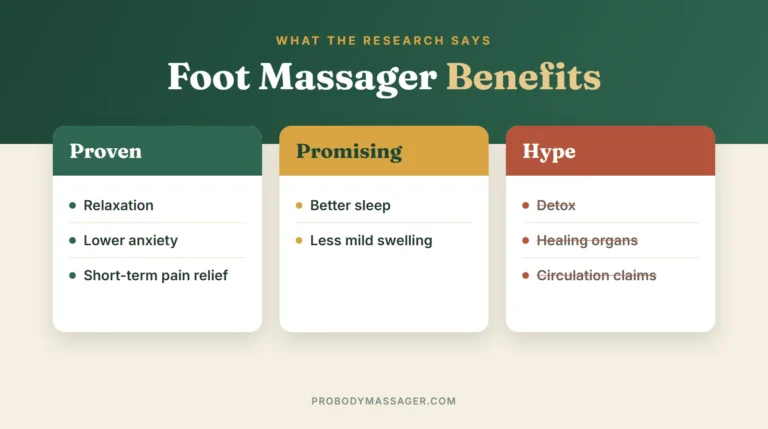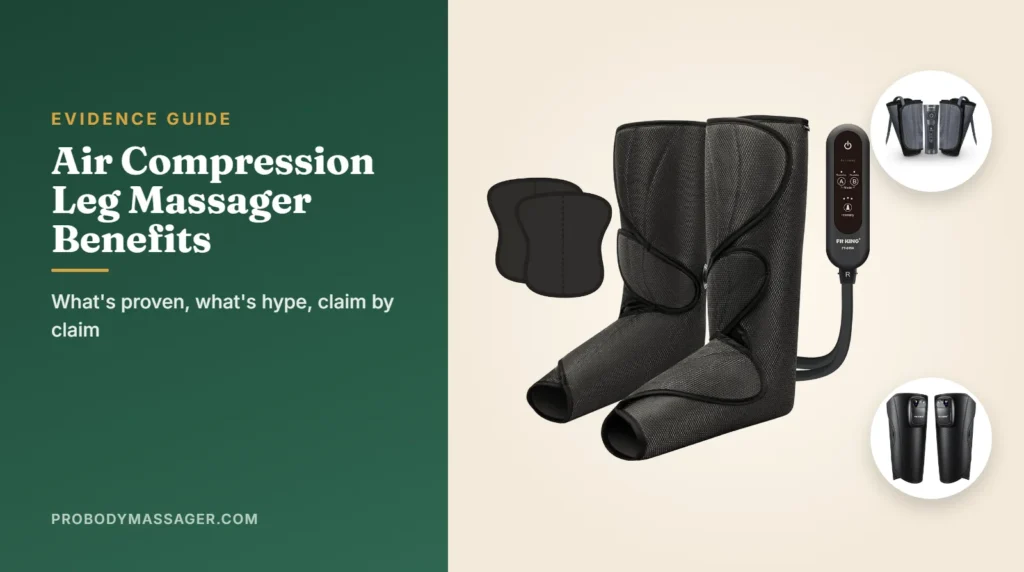
Short answer: an air compression leg massager is a good way to relieve achy, tired legs. That's the use the FDA's category for these devices describes: relieving minor muscle aches and pains and increasing circulation. The bigger claims you'll see, like preventing blood clots or treating lymphedema, come from research on medical compression devices used under supervision, not from home massagers. Here's each claim, sorted by how well it holds up.
Well-Reviewed Air Compression Leg Massagers

Why it's #1: with 20,149 ratings, it has the longest track record of any compression leg massager we checked. Its listing sticks to the claim the FDA category allows: relieving muscle aches and pains and increasing circulation. Owners mention pain relief 732 times.
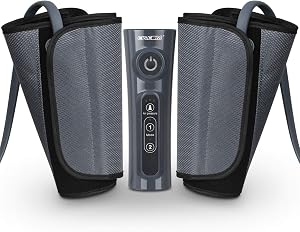
Why it's #2: its wraps move between calves, thighs and arms and fit calves up to 21 inches. Owners describe it as soothing (537 mentions) and helpful for restless legs and cramping. CINCOM is upfront that it's designed for healthy people with minor muscle aches.

Two Devices That Look Alike but Aren't
The FDA puts leg compression devices in two different categories, and the difference explains most of the confusing claims:
| Powered inflatable tube massager | Compressible limb sleeve | |
|---|---|---|
| What it's for | "To relieve minor muscle aches and pains and to increase circulation" by simulating kneading and stroking | "To prevent pooling of blood in a limb" by inflating a sleeve periodically |
| FDA rule | 21 CFR 890.5650, Class II | 21 CFR 870.5800, Class II |
| Typical setting | Home use for comfort | Hospitals and prescribed home use, such as after surgery or stroke |
| Examples | Most leg massagers sold on Amazon | Hospital "SCD" sleeves and prescribed pumps |
The FDA's database lists 158 clearances under the massager category. They include several from Shenzhen Dongjilian, the manufacturer named on the FIT KING and CINCOM listings. The research on preventing clots and treating swelling, though, was done with medical devices used under clinical supervision.
Every Benefit Claim, Rated
| Claim | How well it holds up for a home massager | What the research actually tested |
|---|---|---|
| Relieves tired, achy legs | Supported | The FDA category's stated purpose, and the most common owner experience |
| Less soreness after exercise | Modest | Trivial to moderate effects on soreness in a 2024 review of sports studies |
| Faster performance recovery | Weak | Trivial to small effects on muscle function; no performance benefit in one cycling trial |
| Prevents blood clots | Not for home massagers | Medical IPC in immobile stroke patients in hospital |
| Treats lymphedema | Not for home massagers | Medical pumps as part of supervised lymphedema treatment |
| Heals leg ulcers or helps poor arterial circulation | Not for home massagers | Specialized medical devices; mixed results |
| Eases restless legs and cramps | Owner reports only | No trials of home massagers that we found |
What the Studies Show
- Exercise recovery: a 2024 systematic review and meta-analysis found trivial to small benefits for muscle function and trivial to moderate effects on pain and soreness. Most studies used 20 to 30 minutes at about 80 mmHg. In a trial of trained cyclists, compression between events didn't improve performance.
- Blood clots: in the CLOTS 3 trial of 2,876 immobile stroke patients in hospital, medical IPC lowered the rate of deep vein clots from 12.1% to 8.5%. It also caused skin breaks in 3% of patients, compared with 1.4% without it.
- Lymphedema: a 2026 review of seven trials in chronic leg lymphedema found IPC reduced limb volume, with moderate certainty. The trials excluded people with active infection or an acute clot.
- Leg ulcers: a Cochrane review found IPC may help venous ulcers heal compared with dressings alone, but adding it to compression bandaging gave mixed results.
- Poor arterial circulation: in one 2005 trial, a specialized foot-and-calf IPC device used for hours a day improved walking distance in people with claudication. That's a medical program, not a home massage.
What this means for you: buy a compression leg massager for comfort and tired legs, and treat any recovery boost as a bonus. If you have swelling, a clot history, leg ulcers or circulation disease, talk to your doctor about a prescribed device instead. Our leg massagers for edema guide explains where home devices fit in.
Who Should Check With a Doctor First
The listings' own safety notes, checked October 28, 2026, flag these situations:
- Blood clots, heart problems or inflammation (FIT KING). If one leg is suddenly swollen, red, warm or painful, don't use a massager; see a doctor.
- A pacemaker or other electronic medical device, pregnancy, or the weeks after giving birth (CINCOM)
- Severe blood clots, varicose veins or open wounds (QUINEAR)
- Broken skin or severe pain: stop and get medical advice (FIT KING).
How to Use One Well
- Sit or lie with your legs supported. Raising your legs slightly is comfortable for most people.
- Fit the wraps snugly, not tightly. Check the stated circumference range; CINCOM's wraps fit calves up to 21 inches.
- Start on the lowest pressure. Work up only if it feels comfortable.
- Keep sessions to about 15–20 minutes. FIT KING's cordless model recommends 20 minutes once or twice a day and shuts off after 20.
- Check your skin afterward. Redness that doesn't fade, or broken skin, is a reason to stop. Skin breaks were the main side effect in the CLOTS 3 trial.
The Three Massagers, Up Close
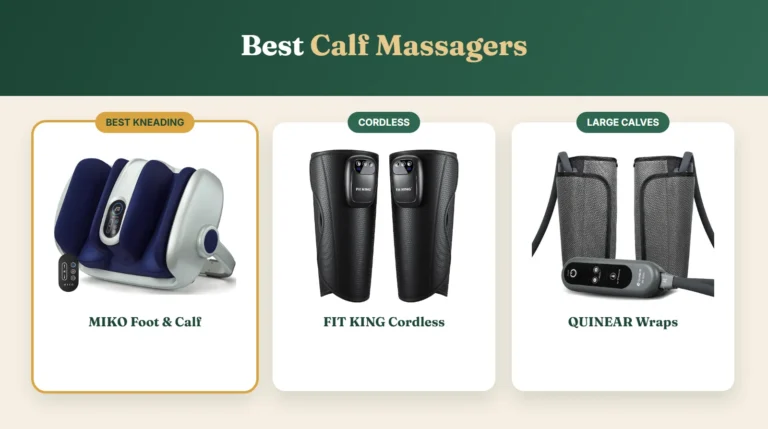
All three squeeze the legs with air. They differ in what they cover, how much calf they fit and whether a tube and cord are involved.
FIT KING Leg Compression Massager: The Most Owner-Tested
FIT KING Leg Compression Massager for Circulation, Feet and Calves (FT-009A)

Large air chambers wrap the feet and calves, with 2 modes and 3 intensities from a handheld controller. The wraps adjust with hook-and-loop straps, and two included size extensions take them to calves up to 28.5 inches, the most room here. It has no heat or thigh coverage, and it runs on a 12V adapter.
Its listing sticks to the claim the FDA category allows: relieving muscle aches and pains and increasing circulation. It holds 4.3 stars from 20,149 ratings; owners say their legs feel better and less swollen, and one mentions help with neuropathy. Fit is mixed, and FIT KING advertises 24 months of coverage.
Key Features
- Feet + calves: large air chambers wrap both.
- 2 modes, 3 intensities: handheld controller.
- Size extensions included: calves 12.5 to 28.5 inches.
- 12V adapter: plug-in power.
- 24 months of coverage: per FIT KING's listing.
What Buyers Say
Owners say it makes their legs feel great and less swollen, call it good value and enjoy using it. Fit is mixed, even with the extensions.
Pros
- 20,149 ratings
- Covers the feet too
- Fits calves up to 28.5"
- 24-month coverage
Cons
- No heat
- No thigh coverage
- Corded, with tubes
Best for Swollen, tired feet and calves at home.
Skip if You want thigh coverage or heat.
CINCOM Leg Massager: Calves, Thighs or Arms
CINCOM Leg Massager for Circulation and Pain Relief (CM-010A)

The CINCOM uses 2+2 large airbags in wraps that fit calves up to 21 inches, and you can move them to the thighs or arms. A handheld controller sets the mode and intensity, it shuts off after 20 minutes, and it runs on a 12V adapter.
CINCOM says it's designed for healthy people seeking temporary relief from minor muscle aches, a refreshingly modest claim. It holds 4.3 stars from 12,154 ratings, with soothing (537 mentions), value (348) and ease of use (299) praised. Owners say it helps restless legs and cramping; pressure and fit get mixed reviews.
Key Features
- 2+2 large airbags: a kneading-style squeeze.
- Calves, thighs or arms: move the wraps where you need them.
- Fits calves up to 21": Velcro adjustment.
- 20-minute auto-off: one session at a time.
- Handheld controller: simple for older users.
What Buyers Say
Owners say it eases restless legs and cramping, goes on easily and feels firm but comforting. Some find the pressure too light, and fit is mixed.
Pros
- Works on calves, thighs and arms
- Modest, honest claims
- 20-minute auto-off
- 12,154 ratings
Cons
- Pressure too light for some
- Mixed fit
- Corded, with tubes
Best for Restless legs and cramping.
Skip if You want strong pressure.
FIT KING Cordless Calf Massager: No Tubes at All
FIT KING Upgraded Cordless Calf Massager, Rechargeable Leg Compression (FT-058A)

These rechargeable wraps have no external controller or tubes, and each works on its own, so you can wear one in a car or walk around the house. They offer 3 modes and 3 intensities, run quietly, charge over USB-C and shut off after 20 minutes. FIT KING gives a 2-year warranty.
It holds 4.3 stars from 1,117 ratings; owners praise its effect on circulation and leg cramps, and one reports 12 to 14 sessions per charge. Fit reports are mixed. See our best calf massagers for how it compares with shiatsu calf machines.
Key Features
- No tubes, no controller: each wrap works on its own.
- 3 modes, 3 intensities: sequence, circulation or combination.
- 20-minute auto-off: USB-C charging.
- Quiet: fine for evenings.
- 2-year warranty: from FIT KING.
What Buyers Say
Owners call it effective for circulation and cramps and easy to use anywhere, including on long car rides. Fit is mixed.
Pros
- Fully cordless
- Wear it while moving
- Quiet
- 2-year warranty
Cons
- Calves only
- Mixed fit
- Fewer ratings: 1,117
Best for People who won't sit still for 20 minutes.
Skip if You want the feet covered too.
Choosing for circulation specifically? Our leg massagers for circulation guide compares more models.
Air Compression Leg Massager FAQ
What are the benefits of an air compression leg massager?
Relief for tired, achy legs, which matches the FDA category's purpose of relieving minor muscle aches and increasing circulation. Research on sports recovery shows small to moderate effects on soreness.
Do air compression leg massagers actually work?
For comfort and soreness, many people find them helpful, and a 2024 review found small benefits for recovery. They don't have proven benefits for treating medical conditions; that research used medical compression devices.
Can a leg compression massager prevent blood clots?
Don't rely on one for that. Clot prevention was shown with medical compression devices in hospital patients, such as in the CLOTS 3 trial. If you're at risk of clots, ask your doctor about a prescribed device.
Are air compression leg massagers safe?
For healthy people using them as directed, generally yes. Check with a doctor first if you have a blood clot, heart problems, a pacemaker, varicose veins, open wounds, or are pregnant, as the listings advise.
How long should you use a leg compression massager?
About 15 to 20 minutes per session. FIT KING suggests 20 minutes once or twice a day, and many models shut off automatically at 20 minutes.
Is a leg massager the same as a lymphedema pump?
No. Some listings mention lymphedema, but lymphedema research used medical pumps as part of supervised treatment. If you have lymphedema, ask your care team which device suits you.
Affiliate Disclosure: ProBodyMassager.com may earn a commission from qualifying purchases made through links on this page, at no extra cost to you. It never changes which products we recommend.