For lower back and hip pain, the best chair is the one that fits you: a seat that isn't too deep, adjustable lumbar support, and a height that keeps your feet flat and your hips level with or slightly above your knees. Where you sit matters too. A desk chair, a living-room recliner and a simple cushion each fix different problems. Here are the picks that check those boxes, backed by thousands of owner reviews:
Best Chairs for Lower Back and Hip Pain

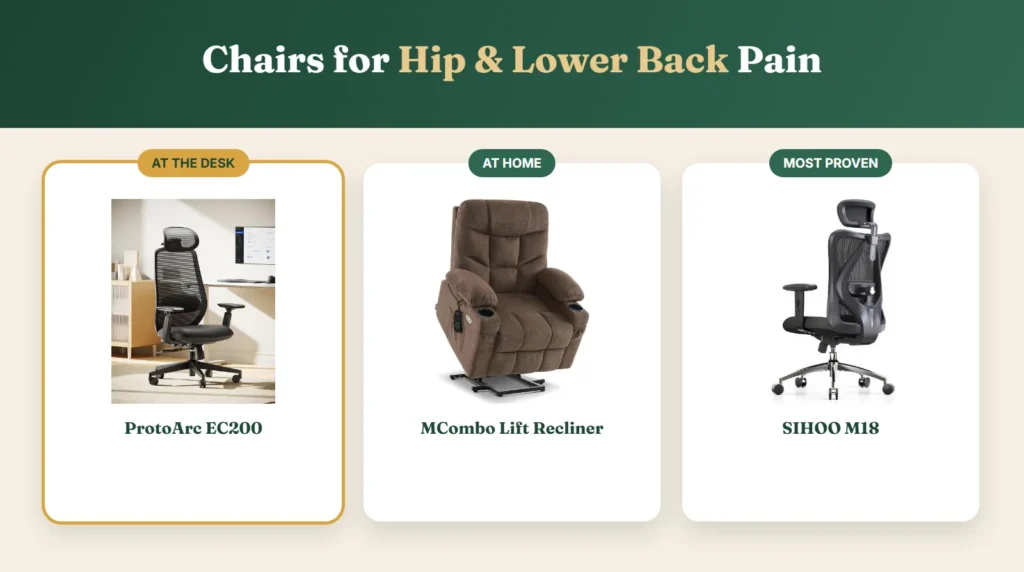
Why it's #1: it has the two adjustments that matter most for hips and lower back: a sliding seat (5 positions) and lumbar support that moves up, down, in and out. 77% of owners give it five stars, and only 1% give it one.

Why it's #2: it's one of the most-reviewed ergonomic chairs on Amazon, and "lumbar support" is a top-praised topic (501 mentions). It fits users 5'6"–6'2" and up to about 330 lb.


5 Chair Features That Matter Most for Hip and Lower Back Pain
| Feature | Why it matters | What to look for |
|---|---|---|
| Seat depth | A seat that's too deep pushes you away from the backrest or presses behind the knees; too shallow leaves thighs unsupported | A sliding seat, or about 2–3 finger-widths between the seat edge and the back of your knees |
| Lumbar support | Fills the curve of the lower back so you don't slump | Adjustable height (and ideally depth) |
| Seat height | Sets the angle at your hips and knees | Feet flat on the floor, thighs parallel to it or knees slightly lower |
| Cushion | Too soft sinks your hips; too hard creates pressure points | Firm, high-density foam, or add a gel/memory-foam cushion |
| Recline or lift | Lets you change position, and a lift chair helps you stand up when hips are stiff | Lockable recline at the desk; power lift at home |
The Mayo Clinic's office ergonomics guide starts with the same basics: choose a chair that supports your spine, and set its height so your feet rest flat on the floor, or use a footrest so your thighs are parallel to it.
If You Sit at a Desk All Day
ProtoArc EC200: The Adjustments Hips Actually Need
ProtoArc EC200 Ergonomic Office Chair with Adjustable Seat Depth

The EC200's seat slides through 5 positions (about 2 inches of travel), so your thighs stay supported while your back stays against the lumbar pad. That's rare at this level. The lumbar adjusts about 2.4 inches in height and 0.8 inch in depth, and four recline locks run from 90° to 130°.
Its 55D high-density foam is designed not to bottom out, a common cause of hip pressure late in the day, and it's BIFMA X5.1 tested. ProtoArc designs it for users 5'4" to 6'0" and under 220 lb, and the listing shows a 3-year manufacturer warranty. It holds 4.6 stars from 465 ratings, with only 1% at 1 star.
Key Features
- Sliding seat: 5 positions, about 2 inches.
- Lumbar support: height and depth adjust.
- 55D high-density foam: resists bottoming out.
- 4 recline locks: 90° to 130°.
- BIFMA X5.1: 3-year warranty.
What Buyers Say
Owners call it comfortable, highly adjustable, easy to assemble and good value; some find the lumbar pad too firm.
Pros
- Seat-depth adjustment
- Height + depth lumbar
- Only 1% one-star
- 3-year warranty
Cons
- Under 220 lb only
- Firm lumbar for some
- Fits 5'4" to 6'0"
Best for Desk workers with hip pain.
Skip if You're over 220 lb.
SIHOO M18: The Proven All-Rounder
SIHOO M18 Ergonomic Mesh Office Chair with Headrest

With 17,199 ratings at 4.3 stars, the SIHOO M18 is a safe, well-tested pick. It supports the head, back, hips and arms, with adjustable lumbar support, headrest and seat height and a breathable mesh back. It passed BIFMA testing, supports up to 150 kg (330 lb) and suits users 5'6" to 6'2".
Owners praise its build, easy assembly and lumbar support (503 mentions). The catch for hip pain: some say the seat cushion feels great at first but turns hard after hours of sitting, and adjustability gets mixed reviews. Pairing it with the cushion below fixes that. SIHOO offers free returns within 30 days.
Key Features
- 4 support points: head, back, hips and hands.
- Adjustable lumbar: plus headrest and seat height.
- Breathable mesh back: stays cool.
- BIFMA tested: up to 330 lb.
- 30-day returns: free, per SIHOO.
What Buyers Say
Owners praise its quality, easy assembly and lumbar support; adjustability is mixed, and the seat can feel hard after hours.
Pros
- 17,199 ratings
- Lumbar support praised
- Up to 330 lb
- Easy assembly
Cons
- Seat firms up over hours
- Mixed adjustability
- 7% one-star
Best for Buyers who want a proven chair.
Skip if You sit 8+ hours without a cushion.
ELABEST X100: For People Who Need to Change Position
ELABEST X100 Ergonomic Mesh Office Chair with Footrest

Staying in one posture for hours is hard on stiff hips. The ELABEST X100 adds a 3-stage recline and an 18-inch pull-out footrest with 2 angles, so you can lean back with your legs up between tasks. Its spring-loaded 3D lumbar support adjusts in height and depth, and its 5D armrests flip up.
It holds up to 300 lb and is BIFMA-certified, and its seat is 18 inches deep. It holds 4.6 stars from 1,549 ratings (81% five-star). Owners call it high quality, comfortable and sturdy, and say the lumbar support helps their posture.
Key Features
- 3-stage recline: lean back between tasks.
- 18-inch footrest: pulls out, 2 angles.
- 3D lumbar support: spring-loaded, height and depth.
- 5D flip-up armrests: tuck under the desk.
- Mesh back: BIFMA-certified, 300 lb.
What Buyers Say
Owners call it high quality, comfortable and easy to assemble, good value, and like the adjustability.
Pros
- Footrest + recline
- 81% five-star
- 300 lb capacity
- Flip-up armrests
Cons
- Needs room to recline
- Many adjustments to learn
- Fewer ratings than the SIHOO
Best for Long workdays with stiff hips.
Skip if Your desk area is tight.
Want heat and massage built into a desk chair? See our best office chairs with heat and massage.
If You Sit on the Couch or in a Recliner
MCombo 7287 Power Lift Recliner: Easier to Get Up
MCombo Power Lift Recliner Chair, Fabric 7287 (Medium)

For many people with hip pain, the worst moment is standing up from a low, soft couch. The MCombo 7287 uses a powered lift to tilt you gently to your feet, and it reclines to 140° with a 4.7-inch extended footrest. It deliberately skips massage and heat to reduce parts that can fail.
It adds a cup holder, USB and USB-C ports and side pockets, takes about 15 minutes to assemble without tools, and is backed by a 2-year limited warranty. MCombo recommends the medium size for users 5'1" to 5'9". It holds 4.5 stars from 3,968 ratings; some find it a little small, with a very firm seat.
Key Features
- Power lift: tilts you gently to your feet.
- 140° recline: 4.7-inch extended footrest.
- No massage or heat: fewer parts to fail.
- USB + USB-C: cup holder and pockets.
- Tool-free assembly: about 15 minutes.
What Buyers Say
Owners call it very comfortable, say the lift helps their mobility, especially after surgery, and find it easy to assemble; some find it small and firm.
Pros
- Power lift
- 3,968 ratings
- Simple, reliable design
- 2-year warranty
Cons
- No massage or heat
- Small for some
- Firm seat
Best for Getting up without straining your hips.
Skip if You want massage or heat.
Want massage and heat in a recliner? See our best recliner chairs with heat and massage. For sciatica-type pain, our massage chairs for sciatica guide compares full-body options.
If You Can't Replace Your Chair
ComfiLife Seat Cushion: The Low-Cost Upgrade
ComfiLife Gel Memory Foam Seat Cushion

A good cushion changes how your hips and tailbone carry weight on almost any seat. The ComfiLife is a U-shaped gel and memory-foam cushion with a cooling gel layer, a non-slip bottom, a carry handle and a washable cover. It works on office chairs, car seats and wheelchairs.
It's one of Amazon's most-reviewed cushions, with 4.4 stars from 109,496 ratings; pain relief alone is mentioned 5,879 times. Owners say it takes pressure off the spine and tailbone and helps with sciatica. Some find it too firm.
Key Features
- U-shaped cutout: eases tailbone pressure.
- Gel + memory foam: with a cooling layer.
- Non-slip bottom: stays in place.
- Washable cover: plus a carry handle.
- Any chair: office, car or wheelchair.
What Buyers Say
Owners call it comfortable and well made and say it relieves tailbone and back pain; some find it too firm.
Pros
- 109,496 ratings
- Fits almost any chair
- Tailbone cutout
- Washable cover
Cons
- Too firm for some
- Raises your seat height
- Foam only, no heat
Best for Hip and tailbone pressure on any seat.
Skip if You prefer a soft, plush seat.
A cushion raises your seat by a couple of inches, so readjust your chair height afterward to keep your feet flat.
Between sittings, a massage gun can work the muscles a chair can only support. Our best massage guns for back pain ranks five, starting with guns you can actually reach your own back with.
How to Set Up Your Chair for Hip and Lower Back Pain
- Set the height first. Raise or lower the seat until your feet rest flat and your thighs are about parallel to the floor; use a footrest if your feet don't reach.
- Adjust seat depth. Sit all the way back and leave about 2–3 finger-widths between the seat edge and the back of your knees.
- Place the lumbar support in the curve of your lower back, roughly at belt level, and set its depth so it supports without pushing.
- Lower the armrests until your shoulders relax and your elbows rest close to your body.
- Try a slight recline (around 100–110°) if your chair allows. Many people find it more comfortable than sitting bolt upright.
- Get up every 30–60 minutes. Stand, walk or stretch briefly. Even the best chair doesn't replace movement.
A better chair can ease discomfort from sitting, but it doesn't treat the cause. See a doctor if your back or hip pain lasts more than a few weeks, keeps you awake at night, follows a fall or injury, or comes with numbness, tingling or weakness in your legs. A physical therapist can also check your sitting posture and suggest exercises.
Want massage or heat for your lower back without replacing your chair? Our best back massagers for lower back pain includes a shiatsu seat cushion with a Lower Back zone that straps onto a desk chair.
Chairs for Back and Hip Pain: Your Questions
What is the best chair for lower back and hip pain?
For desk work, the ProtoArc EC200, because its sliding seat depth and height- and depth-adjustable lumbar support suit hips and lower backs. For the living room, a power lift recliner such as the MCombo 7287 helps you stand up without straining your hips.
What is the best office chair for hip pain?
Choose a chair with adjustable seat depth, adjustable lumbar support and firm, high-density foam. The ProtoArc EC200 has all three. The SIHOO M18 is a proven alternative, ideally paired with a seat cushion.
What type of chair is best for lower back pain at home?
A supportive recliner with a firm seat and good lumbar fill. If getting up is painful, a power lift recliner tilts you to standing. Avoid deep, soft sofas that let your hips sink below your knees.
Should my hips be higher than my knees when sitting?
Level or slightly higher is usually more comfortable for the lower back and hips. Set your seat height so your feet rest flat and your thighs are roughly parallel to the floor, as the Mayo Clinic recommends.
Do seat cushions help hip pain?
Many people find they do. A firm gel or memory-foam cushion spreads pressure away from the hips and tailbone. The ComfiLife cushion has 4.4 stars from more than 109,000 ratings, with pain relief one of its most-praised topics.
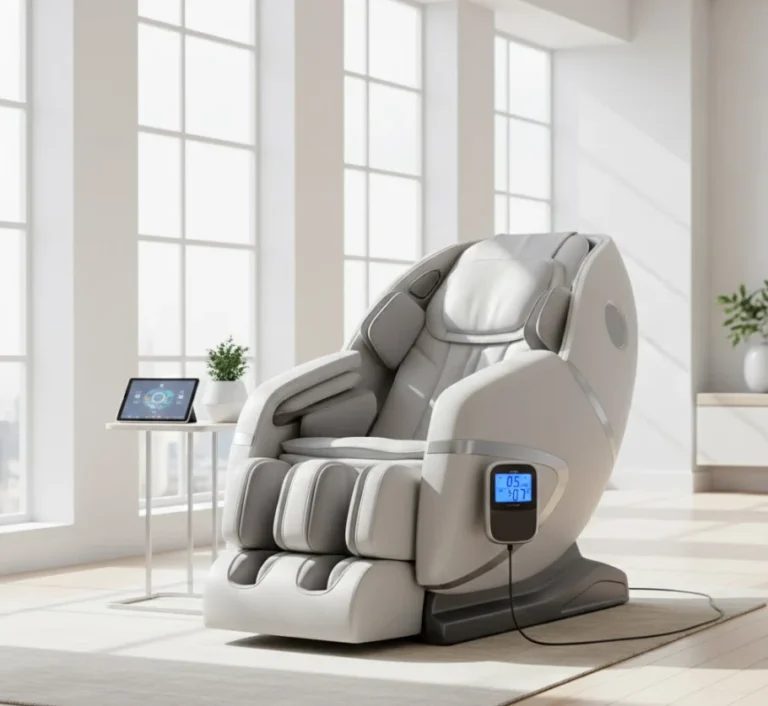
Is a massage chair good for lower back and hip pain?
It can ease muscle tension, but it doesn't replace a supportive everyday chair. See our guide to the best massage chairs for sciatica for full-body options.
How do I know if a chair's seat is too deep?
Sit all the way back. If the seat edge presses into the back of your knees, or you have to perch forward to avoid it, it's too deep. Look for a sliding seat, or add a lumbar pillow to bring you forward.
Affiliate Disclosure: ProBodyMassager.com may earn a commission from qualifying purchases made through links on this page, at no extra cost to you. It never changes which products we recommend.