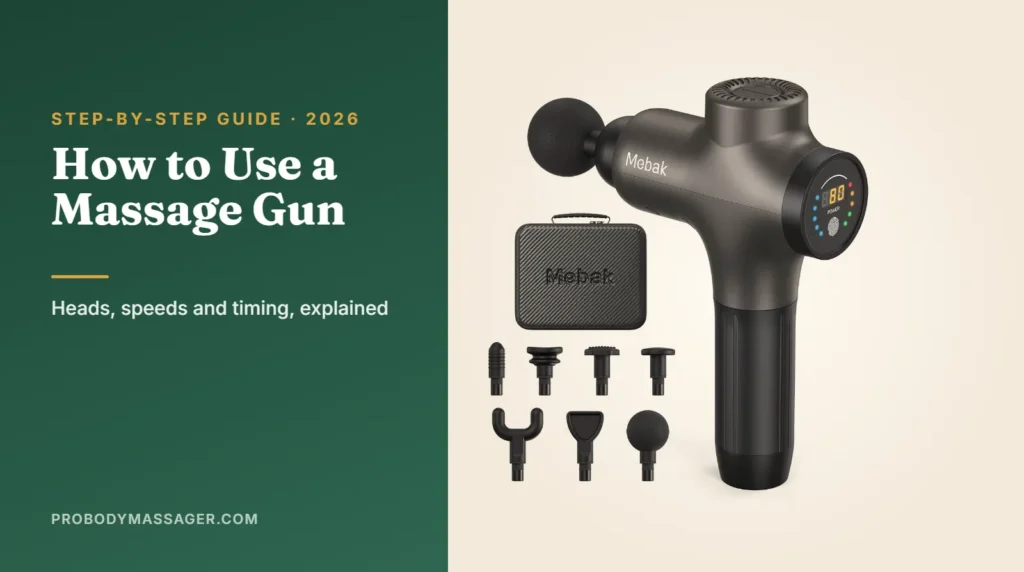
To use a massage gun, start with a ball or soft head on the lowest speed, then glide it slowly along the muscle without pressing. Give each muscle group about 15 to 30 seconds before a workout and 1 to 2 minutes after, keep it on muscle rather than bone or joints, and stop if anything hurts. That's the core of what the makers of Theragun and Hypervolt tell their own customers. The steps, head guide and timing chart below fill in the rest.
3 Massage Guns That Make Good Technique Easier

Why it's #1: its LED pressure indicator shows how hard you're pushing, and pressing too hard is the habit most beginners need to break. Seven heads let you try the attachment types in the guide below, the lowest speed starts at 950 RPM, and it holds 4.7 stars from 19,491 ratings, with just 3% at 1 or 2 stars.

Why it's #2: the Therabody app walks you through guided routines, including ones for back massage and tech neck, while LEDs show your pressure in real time. It comes with only two heads, the Dampener and Standard Ball, but those are the two Therabody tells you to start with. It holds 4.6 stars from 6,813 ratings.
Head, Speed and Time at a Glance
Taken from Therabody's knots and soreness guide, its Theragun Relief FAQ and Hyperice's how-to guide, checked October 28, 2026. Start at the low end of each range.
| Your goal | Start with | Speed | Time |
|---|---|---|---|
| Warm up before exercise | Ball | Higher | 15–30 seconds per muscle group |
| Recover after exercise | Dampener, or Supersoft if still too tender | Low | 1–2 minutes per major muscle group |
| Work out a knot | Ball, then a cone or bullet for pinpoint work | Low | Sweep the muscle for about 1 minute; 15–30 seconds on the knot |
| Everyday tension | Ball | Low | 30–60 seconds per muscle group |
| Tender spots near bone, like shins | Dampener | Lowest | 15–20 seconds, then glide on |
How to Use a Massage Gun, Step by Step
- Choose the head. Use a ball for big muscles, or the Dampener if you're sore. Save the cone or bullet for knots.
- Set the lowest speed. Therabody recommends a low speed for recovery and a higher one for warm-ups. Turn it up only if it feels comfortable.
- Aim at the thick part of the muscle. Thighs, calves, glutes, shoulders and the muscles beside (not on) the spine. Keep it off bones and joints.
- Let it float. Glide without pushing. Therabody's advice is to let the gun do the work; a pressure indicator helps you keep it light.
- Sweep slowly along the muscle. About 15 to 30 seconds per muscle group before exercise and 1 to 2 minutes after, per Hyperice. Therabody caps it at about 2 minutes per area.
- Pause briefly on knots. Hold a trigger point for 15 to 30 seconds, then keep moving.
- Finish with a stretch, and stop if it hurts. Therabody suggests a few deep breaths and a stretch afterward. Pain means stop, not push through.
Which Head Does What
Names vary by brand, but most guns ship with some version of these. Descriptions come from Hyperice's massage gun guide and Therabody's product pages.
| Head | What it's for | Who says so |
|---|---|---|
| Ball (Standard Ball) | Large muscles like the quads and glutes; everyday, all-over massage | Hyperice, Therabody |
| Flat | Dense muscles and broad areas like the back and chest | Hyperice |
| Dampener | Tender or sensitive areas, including spots near bone like ankles and shins | Therabody |
| Cushion or Supersoft | The softest option, for beginners or very tender muscles | Hyperice, Therabody |
| Cone or bullet | Pinpoint work on trigger points and small areas like the hands and feet; keep it off bone | Therabody, Hyperice |
| Thumb | The lower back, trigger points and painful knots | Therabody |
| Fork | Muscles around the spine and Achilles tendon, so you work the muscle and miss the bone | Hyperice |
| Wedge | Shoulder blades and IT bands, with a scraping, flushing motion | Therabody |
Before or After a Workout? What Studies Found
- Before: more range, no lost strength. In a 2020 study of 16 men, 5 minutes with a Hypervolt on the calves increased ankle range of motion by about 18% without reducing strength.
- After: less pain and fatigue. In a 2025 trial of 84 runners at a road race, 10 minutes of percussion on the thighs eased pain and fatigue and improved how recovered they felt, compared with a sham, but didn't change jump performance.
- The bigger picture is modest. A 2026 meta-analysis of 12 trials found low-certainty evidence for better jump recovery and no clear benefit for strength or delayed soreness. In its exploratory analyses, longer sessions were even linked to higher soreness scores. Use a gun because it feels good and loosens you up, not to set records.
Runners can see how this plays out in our best massage guns for runners.
6 Mistakes That Make a Massage Gun Hurt
- Pressing hard. More force isn't more benefit; Therabody's advice is not to press too hard. If the motor bogs down or stalls, as the RENPHO Reach Curve's is designed to, ease off.
- Parking in one spot. Therabody's Theragun Relief guide suggests about 15 to 20 seconds on an area before you glide on.
- Going too long. Hyperice puts most muscle groups at 30 to 60 seconds, up to 2 minutes for big ones like the quads, and 30 seconds or less for calves.
- Hitting the wrong spot. Bones, joints, the front and sides of the neck, the head and eyes, the belly and injuries are off-limits. Our guide to where not to use a massage gun explains why, and our massage gun neck guide covers the back of the neck.
- Using it while drowsy. Therabody and Bob and Brad both say not to use their guns while sleeping.
- Massaging a suspicious calf. A swollen, warm, painful calf can be a blood clot. Don't massage it; MedlinePlus lists deep vein thrombosis symptoms to check first.
How Often Can You Use a Massage Gun?
No study sets a daily limit. Hyperice says daily use at lower intensities is generally safe, suggests starting with 3 or 4 sessions a week, and recommends alternating days or easing off after hard workouts. Follow your own gun's cap too: RENPHO says no more than 30 minutes per session. If an area is bruised or more sore the next day, give it a rest.
The Three Guns, Up Close
Each of these guns makes good technique easier: one shows your pressure, one guides you through routines and one helps you reach your own back.
1. Mebak 3: Find the Right Pressure
Mebak 3 Massage Gun Deep Tissue

The Mebak 3 pairs 12 mm of amplitude and 53 lb of stall force with an LED pressure indicator that helps you find a comfortable pressure, the skill most beginners get wrong. Its 5 speeds run from 950 to 3,000 RPM, it weighs about 1.68 lb and Mebak rates it at 39 to 50 dB.
Seven heads and a carrying case come in the box. It holds 4.7 stars from 19,491 ratings. Owners praise its pain relief, value and battery life, though some say it stopped working after about three months.
Key Features
- LED pressure indicator: find a comfortable pressure.
- 950 RPM start: 5 speeds in all.
- 12 mm, 53 lb stall force: deep when you need it.
- 7 heads + case: match the head to the muscle.
- 39-50 dB: per Mebak.
What Buyers Say
Owners praise its pain relief, value, battery life and range of heads; some report units failing after a few months.
Pros
- Pressure feedback
- Low first speed
- 7 heads
- 4.7 stars
Cons
- No app guidance
- No extension handle
- Some early failures
Best for Beginners who want feedback.
Skip if You need help reaching your back.
2. Theragun Prime (6th Gen): Guided Routines
Therabody Theragun Prime 6th Gen Deep Tissue Massage Gun

The Theragun Prime uses one button for its 5 speeds, LEDs for real-time pressure feedback and Therabody's triangle grip for reaching your back and shoulders. Therabody lists 16 mm of amplitude and about 120 minutes of battery.
Therabody says its app's guided routines show the right speed, grip, attachment and time for each area, which takes the guesswork out of your first weeks. It holds 4.6 stars from 6,813 ratings; owners praise its quality and pain relief, but battery life and reliability get mixed reviews.
Key Features
- App routines: speed, grip, head and time.
- Pressure LEDs: real-time feedback.
- Triangle grip: reach your back and shoulders.
- 16 mm amplitude: per Therabody.
- Drop-resistant shell: up to 10 feet.
What Buyers Say
Owners call it high quality and powerful, especially on sore muscles; battery life and reliability are mixed.
Pros
- Guided app routines
- Pressure LEDs
- Triangle grip
- 6,813 ratings
Cons
- Only 2 attachments
- Mixed battery reports
- 1-year warranty
Best for First-time users who want a coach.
Skip if You'd rather not use an app.
3. RENPHO Reach Curve: Reach Your Own Back
RENPHO Reach Curve Massage Gun with Extension Handle, 4-in-1
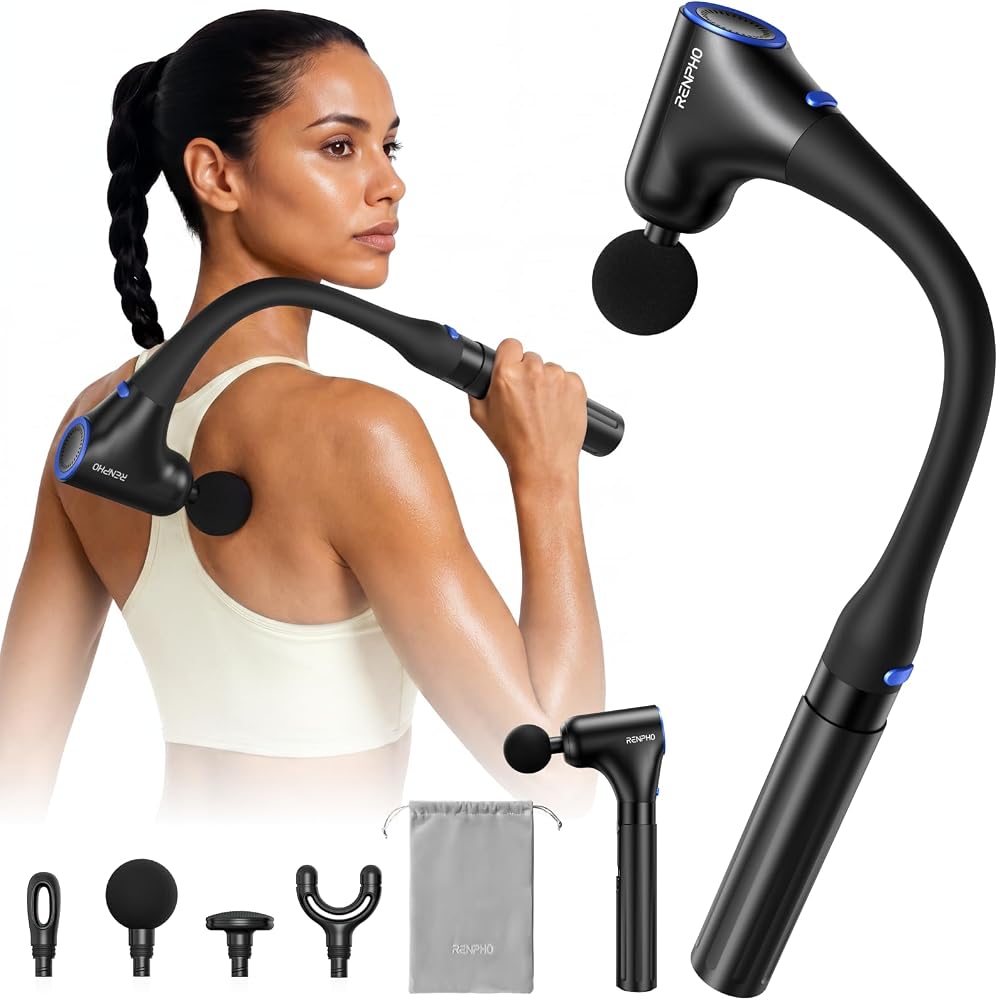
The Reach Curve solves the hardest part of using a gun on yourself: reaching your own back. Its handle extends from 10 to 18.5 inches, and a curved extension handles the lower back. It has 10 mm of amplitude and 4 speeds from 1,000 to 3,000 RPM, and it shuts off after 10 minutes.
The motor stalls under too much pressure, a built-in cue to ease off. It holds 4.4 stars from 10,293 ratings; owners like its power and value, but many report it stopped working after about 4 months. For more options, see our best massage guns for back pain.
Key Features
- Telescopic handle: 10 to 18.5 inches.
- Curved extension: for the lower back.
- Stall protection: a cue to ease off.
- 10-minute auto-off: caps each session.
- 4 speeds: 1,000 to 3,000 RPM.
What Buyers Say
Owners call it effective and good value; battery life is mixed, and many report units that stopped working after about 4 months.
Pros
- Reaches your own back
- 10-minute auto-off
- Stall protection
- Five heads
Cons
- Some failures after months
- Mixed battery reports
- Lower amplitude
Best for Solo users.
Skip if Durability is your top concern.
Gentler hands needed? Our best massage guns for seniors focus on light, low-speed guns.
How to Use a Massage Gun FAQ
How long should you use a massage gun on one muscle?
About 30 to 60 seconds for most muscle groups, up to 2 minutes for large ones like the quads, according to Hyperice. Therabody also suggests about 2 minutes as the upper limit per area. On a single knot, 15 to 30 seconds is enough.
Should you use a massage gun before or after a workout?
Either. Before, keep it short, about 15 to 30 seconds per muscle at a higher speed. After, go slower and longer, about 1 to 2 minutes per major muscle. Studies show more range of motion before exercise and less pain and fatigue after, but no performance boost.
Can you use a massage gun every day?
Usually, at a low intensity. Hyperice says daily use is generally safe, suggests starting with 3 or 4 sessions a week, and recommends easing off after hard workouts. Rest any area that's bruised or more sore the next day.
Which massage gun attachment should a beginner use?
A ball head or a soft one. Hyperice calls its cushion head the softest option for beginners, and Therabody suggests the Standard Ball for knots and the Dampener for sore muscles.
Should a massage gun hurt?
No. It should feel firm but comfortable. If it hurts, lower the speed, switch to a softer head or lighten your grip, and stop if the pain continues.
Where should you not use a massage gun?
On bones, joints, the front and sides of the neck, the head and eyes, the belly, the groin, injuries, and a leg that might have a blood clot. Stick to the thick part of muscles.
Affiliate Disclosure: ProBodyMassager.com may earn a commission from qualifying purchases made through links on this page, at no extra cost to you. It never changes which products we recommend.